We design advanced, chemical-free hospital disinfection technologies that actively eliminate pathogens in real time. By combining UVC, ozone, and intelligent control systems, we help healthcare facilities reduce infections, protect patients and staff, and set a new standard of hospital hygiene.



Ozone disinfection in hospitals
deep, chemical-free space sterilization
In hospital environments, where pathogens hide not only on visible surfaces but also in the air, textiles, crevices, air-conditioning systems, and materials that cannot be chemically treated without damage, ozone (O₃) represents one of the most powerful and comprehensive disinfection methods. It penetrates the entire volume of a room and breaks down microorganisms as well as odor molecules-without leaving any residues.
Ozone is not just a “gas for odors.” In a properly designed and controlled system, it is a full-scale decontamination technology that has been used for decades in hospitals, the food industry, and pharmaceutical production, and is now experiencing a renaissance thanks to precise generators, sensors, and safe-use protocols.
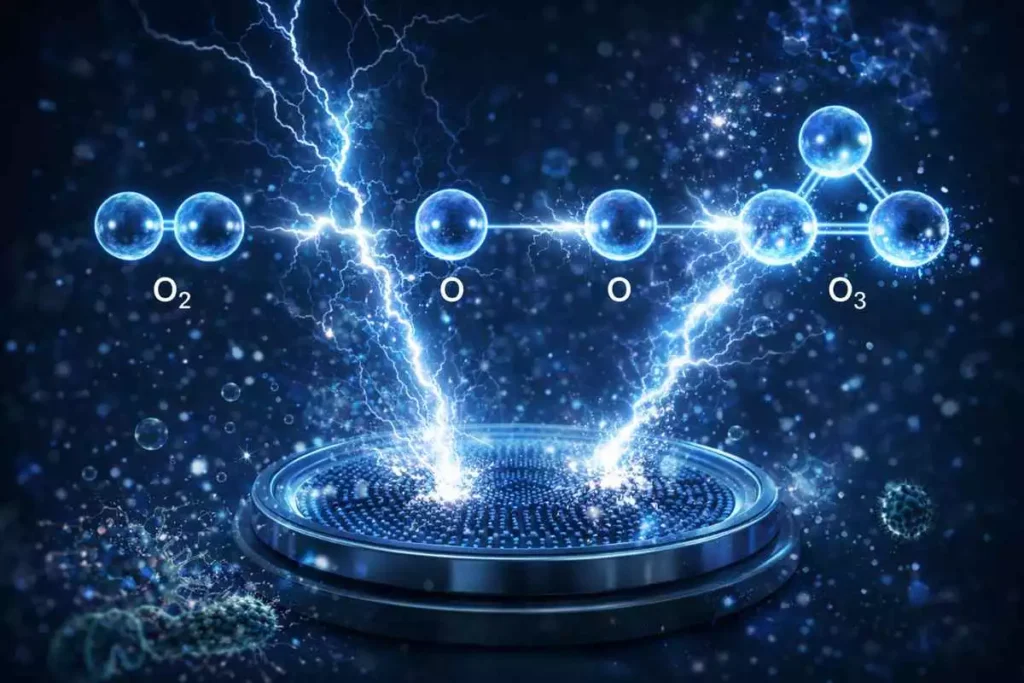
What Is Ozone and Why It Is So Powerful
Ozone is a triatomic form of oxygen (O₃) with an exceptionally high oxidation potential – significantly higher than chlorine or hydrogen peroxide. This is why it can destroy bacterial cell walls, damage viral envelopes, and oxidize proteins and lipids that are essential for microbial survival.
This mechanism means microorganisms cannot “adapt” or develop resistance, as they can with some chemical disinfectants.
After the process is completed, ozone naturally decomposes back into oxygen, leaving no chemical residues, not damaging surfaces, and not burdening hospitals with toxic waste-an essential advantage in environments where dozens or hundreds of rooms are disinfected daily.
How Ozone Destroys Viruses, Bacteria, and Fungi
Ozone acts through oxidation—rapid reactions with cellular structures that break down proteins, lipids, and nucleic acids, leading to immediate inactivation. Unlike UVC, which works only where the light reaches, ozone as a gas penetrates all corners of a room, into textiles, mattresses, HVAC systems, filters, cable ducts, and joints where pathogens often hide and where manual disinfection is practically impossible. See ozone generator systems designed for hospital decontamination.
Studies confirm ozone’s high effectiveness against a broad spectrum of pathogens, including viruses (e.g., coronaviruses), bacteria, and fungi. With properly selected concentrations and exposure times, log-reduction levels comparable to the most effective chemical methods can be achieved.
Why Ozone Is Ideal for Hospitals
Hospitals need solutions that are fast, effective, and comprehensive, because pathogens do not hide only on floors and tables, but also in mattresses, curtains, HVAC systems, and technical infrastructure.
Ozone enables deep decontamination of the entire space as a single unit -not just surfaces – making it an ideal complement to UVC and standard hygiene procedures.
European and international studies confirm that ozone disinfection can significantly reduce microbial loads in hospital rooms, especially after patient discharge, isolation, or during outbreaks of hospital-acquired infections.
Safety and Controla kontrola
Modern ozone systems are designed to operate in precisely controlled cycles, with concentration monitoring and automatic ventilation, ensuring that rooms are re-entered only after ozone has safely decomposed back into oxygen.
International agencies such as WHO and OSHA define safe exposure limits and procedures, which are now standard parts of professional systems.
Why Ozone Belongs in the zeroPATH Protocol
Ozone is ideal as a nighttime or between-procedure decontamination mode that complements continuous air disinfection via germicidal UVC modules and rapid surface disinfection with open UVC. This creates a hybrid system that protects hospitals 24/7 while ensuring deep sterilization when rooms are unoccupied.
Is ozone dangerous?
Yes, when inhaled directly at high concentrations. That is why it is used only in unoccupied spaces with automatic ventilation and sensors.
Does ozone leave residues?
No, it decomposes back into oxygen.
Can it remove odors?
Yes, it breaks down odor molecules rather than masking them.